

Introduction
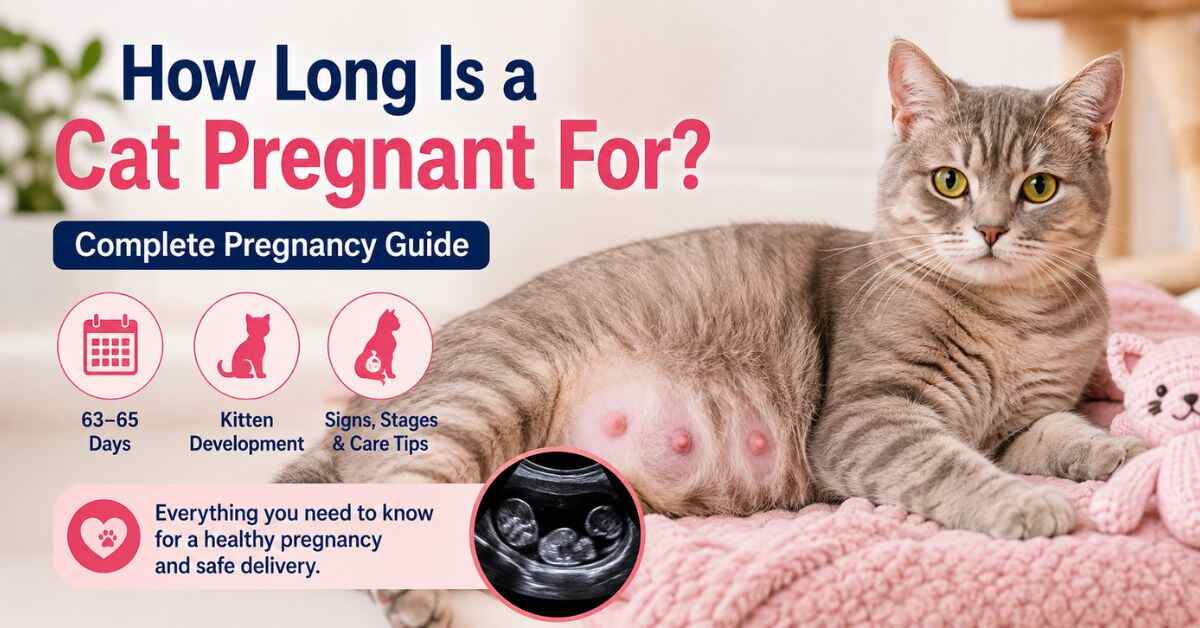
If your cat has recently mated, you may be wondering, how long is a cat pregnant for? Understanding the length of a cat’s pregnancy can help you prepare for the arrival of kittens and recognize whether your cat is progressing normally.
A typical cat pregnancy lasts about 63 to 65 days, which is roughly nine weeks. However, pregnancy length can vary. Some cats may give birth a little earlier or later, with a normal gestation period often falling around 58 to 72 days depending on the individual cat and circumstances.
During those weeks, your cat’s body changes rapidly. Her appetite may change, her abdomen may become larger, and her behavior can become noticeably different as the kittens develop.
Whether this is your first experience with a pregnant cat or you’re simply curious about feline reproduction, knowing what to expect can make the process much less stressful.
In this guide, we’ll explain how long is a cat pregnant for, break down the pregnancy timeline, discuss common signs of pregnancy, explain what happens before labor, and share practical care tips for the mother cat.
How Long Is a Cat Pregnant For?
So, how long is a cat pregnant for?
The average pregnancy for a cat is approximately 63 to 65 days, or about nine weeks.
However, not every pregnancy follows exactly the same schedule. Some cats may deliver kittens around day 60, while others may carry their kittens for closer to 70 days.
| Cat Pregnancy Stage | Approximate Timing | What Happens |
| Mating and conception | Day 0 | Fertilization may occur |
| Early pregnancy | Days 1–21 | Embryos develop and implant |
| Middle pregnancy | Days 22–42 | Kittens grow rapidly |
| Late pregnancy | Days 43–60+ | Kittens develop and prepare for birth |
| Final days | Around days 60–70 | Labor may begin |
| Average birth | Around days 63–65 | Most kittens are delivered |
The exact due date can be difficult to determine if you don’t know the precise day mating occurred.
For that reason, veterinarians often use physical examination and imaging, such as ultrasound, to help estimate pregnancy and kitten development.
Understanding the Cat Gestation Period
A cat’s pregnancy is called gestation. During gestation, fertilized eggs develop into embryos and eventually fully formed kittens.
Unlike humans, cats have a relatively short pregnancy. This allows them to reproduce multiple times during a breeding season.
Cats are also induced ovulators, meaning mating can stimulate ovulation. A female cat may mate with more than one male during her heat cycle, which means kittens in the same litter can potentially have different fathers.
The length of pregnancy can vary based on several factors, including:
- The individual cat
- The timing of ovulation
- The number of kittens
- Overall health
- Breed and genetics
- Whether the exact mating date is known
Therefore, it’s better to think of the average pregnancy as a range rather than expecting every cat to deliver exactly on day 63.
Cat Pregnancy Timeline: Week by Week
Knowing the pregnancy timeline makes it easier to understand what’s happening inside your cat.
Week 1: Mating and Fertilization
During the first week, pregnancy may not be obvious at all.
After mating, fertilization can occur as the eggs and sperm meet. The fertilized eggs then begin their journey toward the uterus.
Your cat may continue behaving completely normally during this stage.
You probably won’t see obvious physical changes yet.
Week 2: Early Embryonic Development
During the second week, the developing embryos continue to grow and eventually move toward implantation in the uterus.
Your cat may still look and act normal.
Some cats experience subtle behavioral changes, but these aren’t reliable enough to confirm pregnancy.
If you suspect your cat is pregnant, avoid giving medications or supplements unless your veterinarian recommends them.
Week 3: Early Signs May Appear
Around the third week, some cats begin showing one of the classic signs of pregnancy: pinker and slightly enlarged nipples.
This change is sometimes called “pinking up.”
Other possible changes include:
- Increased affection
- Mild appetite changes
- Sleeping more
- Occasional nausea
- Slight weight gain
However, these symptoms aren’t proof of pregnancy.
A veterinarian can provide a more reliable assessment.
Week 4: Pregnancy Becomes Easier to Detect
By approximately the fourth week, pregnancy may become more noticeable.
The developing kittens are growing, and your cat’s abdomen may begin to look slightly rounder.
Her appetite may also increase.
At this stage, a veterinarian may be able to confirm pregnancy using an ultrasound examination.
If you aren’t certain when mating occurred, veterinary assessment can also help estimate how far along the pregnancy may be.
Week 5: Rapid Kitten Growth
The kittens are now developing rapidly.
Your cat’s abdomen may become significantly more noticeable, especially if she is carrying several kittens.
Her nutritional needs are also becoming increasingly important.
Rather than simply feeding large amounts of food, provide a balanced, nutritious diet appropriate for pregnancy. Your veterinarian can recommend the best feeding approach based on your cat’s health and body condition.
Week 6: Visible Pregnancy
By week six, your cat may clearly look pregnant.
You may notice:
- A larger abdomen
- Increased appetite
- More sleeping
- Reduced interest in strenuous activity
- Enlarged mammary glands
- More affectionate or withdrawn behavior
Avoid repeatedly touching or pressing her abdomen.
Even if you’re curious about the kittens, abdominal manipulation can cause unnecessary stress and may potentially harm the pregnancy.
Week 7: Preparing for Birth
During the seventh week, the kittens continue gaining size and developing.
Your cat may begin searching for a quiet and comfortable place to rest.
This is a good time to prepare a nesting area.
Choose a location that is:
- Quiet
- Warm
- Clean
- Away from heavy household traffic
- Easy for you to monitor
- Safe from other pets and young children
Use clean, washable bedding that can be replaced after delivery.
Week 8: Late Pregnancy
By week eight, your cat may appear very pregnant.
The kittens are approaching their final stage of development, and your cat may spend more time resting.
Her behavior may change again as she gets closer to labor.
Some cats become more affectionate, while others prefer privacy.
You may also notice her investigating potential nesting locations.
Continue providing fresh water, appropriate nutrition, and a calm environment.
Week 9: Labor May Be Approaching
Around week nine, birth may occur at any time.
Remember that the exact timing varies from cat to cat.
There are several signs that labor may be approaching, including:
- Restlessness
- Increased vocalization
- Frequent grooming
- Hiding or seeking privacy
- Reduced appetite
- Nesting behavior
- Panting or rapid breathing
- A drop in body temperature shortly before labor
- Milk appearing in the mammary glands
Not every cat will show all of these signs.
Once labor begins, the process can progress relatively quickly, so it’s important to keep your veterinarian’s contact information available.
Signs Your Cat May Be Pregnant
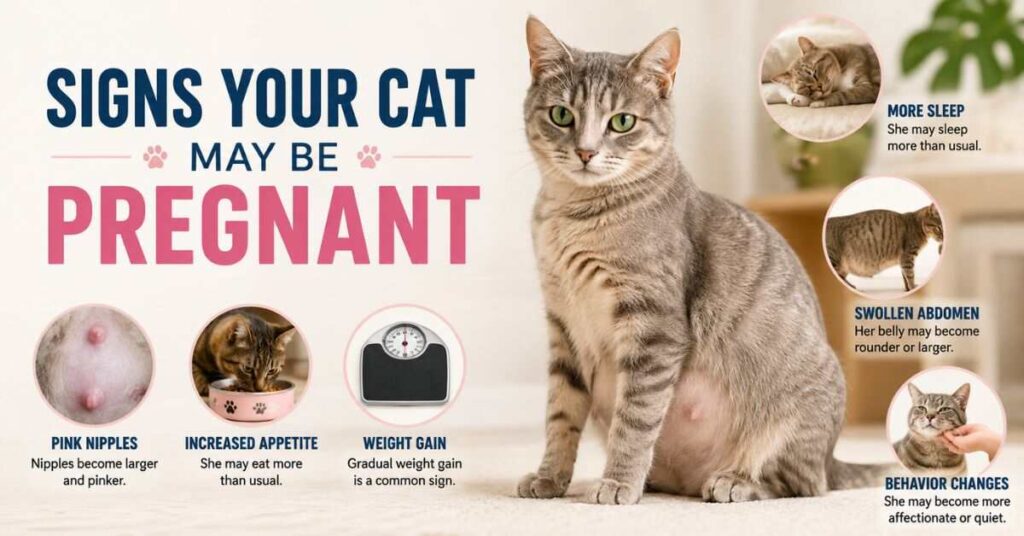
If you aren’t sure whether your cat is pregnant, several signs may provide clues.
1. Pinker Nipples
One of the earlier noticeable signs is nipples becoming more prominent and pink.
However, nipple changes can happen for reasons other than pregnancy, so this sign alone isn’t conclusive.
2. Increased Appetite
A pregnant cat may need more calories as the kittens grow.
Her appetite can increase, particularly during the middle and later stages of pregnancy.
3. Weight Gain
Gradual weight gain is common during pregnancy.
However, sudden or excessive weight gain isn’t necessarily normal and should be discussed with a veterinarian.
4. Enlarged Abdomen
As the kittens grow, your cat’s belly becomes larger.
Never assume that an enlarged abdomen automatically means pregnancy. Parasites, fluid accumulation, organ enlargement, and other health problems can also cause abdominal enlargement.
5. Behavioral Changes
Pregnancy can affect behavior.
Your cat may become:
- More affectionate
- More tired
- More independent
- More vocal
- More interested in quiet spaces
Behavior differs considerably between individual cats.
How Can a Veterinarian Confirm Cat Pregnancy?
If you believe your cat is pregnant, a veterinary examination is the safest way to confirm it.
Depending on the timing, your veterinarian may use:
Physical Examination
A veterinarian may examine your cat and look for physical signs associated with pregnancy.
However, owners should never attempt to feel for kittens themselves.
Ultrasound
Ultrasound can help confirm pregnancy and assess developing kittens.
It may be particularly useful relatively early in pregnancy.
X-Ray
Later in pregnancy, X-rays can help visualize the developing kittens’ skeletons.
This can sometimes help veterinarians estimate the number of kittens, although the exact count isn’t always guaranteed.
A veterinarian can decide which examination is most appropriate based on how far along the pregnancy appears to be.
What Should You Feed a Pregnant Cat?
Nutrition is especially important during pregnancy.
As kittens grow, your cat requires adequate energy and nutrients to support both herself and her developing litter.
Many veterinarians recommend a high-quality, nutritionally complete kitten food during pregnancy and nursing because kitten formulas are designed to provide higher levels of energy and nutrients.
However, your cat’s specific nutritional needs can vary.
Helpful Feeding Tips
- Provide fresh water at all times.
- Feed a complete and balanced diet.
- Follow your veterinarian’s recommendations.
- Offer smaller meals more frequently if a large abdomen makes big meals uncomfortable.
- Monitor her body condition and weight.
- Avoid sudden diet changes.
- Don’t give supplements unless recommended by a veterinarian.
Calcium supplements, in particular, should not be given casually. Too much calcium can create health problems rather than preventing them.
How to Prepare for Your Cat’s Labor
Preparing ahead of time can make the final days much easier.
Create a comfortable nesting area before your cat goes into labor.
It is ideal to use a sturdy box or a suitable enclosed space lined with clean towels or washable blankets.
Keep the area warm and quiet, but don’t force your cat to stay there.
Some cats will choose their own location despite your preparation.
You should also have:
- Clean towels
- Extra washable bedding
- Fresh water
- Food nearby
- A safe, quiet room
- Your veterinarian’s contact information
- A carrier available in case emergency transportation is necessary
The goal isn’t to interfere with the birth. Instead, your job is to provide a safe environment and monitor for problems.
What Happens During Cat Labor?
Cat labor generally occurs in stages.
Stage 1: Early Labor
During early labor, your cat may become restless and repeatedly move between locations.
She may groom herself frequently, vocalize more than usual, or search for her preferred nesting area.
Some cats lose interest in food.
Stage 2: Delivery of the Kittens
During active labor, contractions become stronger and kittens begin to be delivered.
The time between kittens can vary.
Some kittens arrive relatively close together, while others may take longer.
Avoid unnecessary interference.
Most mother cats instinctively know how to clean and care for their newborns.
Stage 3: Delivery of Placentas
Each kitten is generally followed by its placenta.
The mother may eat the placentas, which is normal behavior.
However, if you’re concerned that something has been retained or the labor doesn’t seem to be progressing normally, contact your veterinarian.
When Should You Call a Veterinarian?
Most cat pregnancies and births progress without major problems, but complications can occur.
Contact a veterinarian promptly if you notice concerning symptoms.
Seek professional veterinary advice if:
- Your cat appears seriously ill or extremely weak.
- She has significant difficulty breathing.
- She experiences prolonged, intense straining without producing a kitten.
- There is heavy bleeding.
- A kitten appears stuck.
- She develops foul-smelling discharge.
- She collapses.
- You believe pregnancy has continued significantly beyond the expected period.
- She stops eating and appears unwell.
- You are concerned about her condition at any point.
Don’t rely solely on online information when a pregnant cat appears to be in distress.
A veterinary professional can assess the mother and kittens and determine whether intervention is needed.
Can a Cat Get Pregnant More Than Once a Year?
Yes.
Cats can potentially become pregnant multiple times within a year because their reproductive cycle can allow repeated pregnancies.
This is one reason responsible breeding and population control are important.
If you don’t plan to breed your cat, talk with your veterinarian about spaying.
Spaying prevents future pregnancies and also helps reduce the number of unwanted kittens entering shelters and rescue systems.
How Many Kittens Does a Cat Usually Have?
Litter size varies considerably.
A cat may have only one or two kittens, while larger litters can contain several kittens.
Factors that may influence litter size include:
- Age
- Health
- Genetics
- Breed
- Previous pregnancies
- Individual reproductive factors
Don’t try to estimate litter size by looking at your cat’s belly.
Veterinary imaging may provide a better estimate, especially later in pregnancy.
Common Mistakes to Avoid During Cat Pregnancy
Caring for a pregnant cat doesn’t have to be complicated, but several mistakes can cause unnecessary problems.
Avoid These Common Mistakes
Don’t press on her belly.
You could hurt her or cause unnecessary stress.
Don’t give human medications.
Many human medicines can be dangerous or toxic to cats.
Don’t give supplements without veterinary advice.
More isn’t always better.
Don’t force her into a nesting box.
She may choose another safe location.
Don’t make major diet changes suddenly.
Gradual dietary changes are generally easier for cats to tolerate.
Don’t ignore serious labor problems.
When something seems wrong, contacting your veterinarian is safer than waiting.
Conclusion
So, how long is a cat pregnant for? In most cases, a cat’s pregnancy lasts approximately 63 to 65 days, or about nine weeks. However, individual pregnancies can vary, so the exact delivery date isn’t always predictable, especially when the mating date is unknown.
During pregnancy, watch for gradual physical and behavioral changes, provide nutritious food and fresh water, prepare a quiet nesting area, and avoid unnecessary handling of your cat’s abdomen.
Most importantly, don’t hesitate to contact a veterinarian if your cat appears sick, experiences difficult labor, or goes beyond the expected pregnancy period without giving birth.
Understanding the feline pregnancy timeline allows you to prepare confidently while giving the mother cat the calm, safe environment she needs. For more practical, trustworthy information about cat behavior, care, food, and health, visit KittyCareZone.com.
The average cat pregnancy lasts around 63 to 65 days, or approximately nine weeks. However, normal pregnancy length can vary, and some cats may give birth somewhat earlier or later.
Common signs include pinker nipples, increased appetite, gradual weight gain, an enlarged abdomen, increased sleeping, and behavioral changes. A veterinarian can confirm pregnancy more reliably through examination and imaging.
Yes, pregnancy can sometimes extend toward 70 days. However, if you believe your cat is significantly overdue or she shows signs of illness or difficult labor, contact your veterinarian for guidance.
A cat is typically pregnant for about nine weeks. The average gestation period is approximately 63–65 days, although individual pregnancies can vary.
Provide a quiet, warm, clean nesting area, make sure she has access to water and appropriate food, minimize stress, and keep your veterinarian’s contact information available. Monitor her closely without unnecessarily interfering with labor.

Ali Ahmad /Passionate writer sharing informative, engaging, and easy-to-read articles across different topics. Focused on delivering valuable content that helps readers learn, explore, and stay inspired every day.