


If you’ve ever spotted a cat darting behind a dumpster or freezing mid-step the moment you made eye contact, you’ve likely witnessed feral cat behavior firsthand. These cats aren’t being rude or dramatic they’re following instincts shaped by a life without human contact.
Understanding feral cat behavior helps you respond the right way, whether you’re trying to help a colony near your home, worried about a cat in your yard, or simply curious about why these animals act so differently from your cuddly house cat. In this guide, we’ll break down what makes feral cats tick, how to tell them apart from strays, and what you can actually do to help.
What Is a Feral Cat, Exactly?
A feral cat is a domestic cat (Felis catus) that was either born in the wild or has lived without human contact for so long that it has reverted to a wild state. Unlike stray cats, which were once someone’s pet and may still be somewhat comfortable around people, feral cats typically have little to no positive association with humans.
This distinction matters a lot when it comes to feral cat behavior, because it shapes almost everything about how these cats act, communicate, and survive.
Feral vs. Stray: Key Differences
People often use “feral” and “stray” interchangeably, but the behavioral differences are significant.
| Trait | Feral Cat | Stray Cat |
| Human contact history | Little to none | Was previously socialized |
| Comfort near people | Avoids humans entirely | May approach cautiously |
| Vocalization toward people | Rare | Common (meowing for attention) |
| Eye contact | Avoids or freezes | Often makes eye contact |
| Body posture around humans | Crouched, ready to flee | Relaxed or curious |
| Chance of rehoming | Low without extensive work | Higher, especially if young |
| Typical living situation | Colonies in hidden areas | Near homes, businesses |
Recognizing these differences early can save you time, help you approach the situation safely, and set realistic expectations if you’re hoping to help a cat in your neighborhood.
Core Traits of Feral Cat Behavior
Feral cats communicate and survive very differently from indoor pets. Here’s what typically defines their behavior.
1. Extreme Wariness Around Humans
The most obvious sign of feral cat behavior is fear-driven avoidance. Feral cats generally won’t approach people, and if cornered, they may hiss, growl, or flatten their ears as a warning before fleeing.
This isn’t aggression for the sake of it it’s a survival response. In the wild, trusting the wrong creature can be fatal, so feral cats default to caution.
2. Nocturnal or Crepuscular Activity
Many feral cats are most active at dawn, dusk, or overnight. This timing reduces encounters with humans, dogs, and daytime predators, while aligning with when small prey like rodents are also active.
3. Strong Colony Structures
Feral cats often live in colonies, especially in areas with a steady food source. These groups usually form around related females (a matriarchal structure), while males tend to roam more widely between colonies.
Colony behavior includes:
- Shared territory boundaries marked by scent
- Cooperative kitten-rearing among related females
- Loose hierarchies that shift based on resources
- Minimal direct conflict when food is sufficiently distributed
4. Scent Marking and Territory Defense
Feral cats rely heavily on scent to communicate. You might notice:
- Facial rubbing on trees, fences, or feeding stations
- Scratching on visible surfaces
- Urine marking around territory edges
- Avoidance of areas recently marked by unfamiliar cats
5. Minimal Vocalization Toward Humans
Pet cats often meow specifically to communicate with people it’s a behavior largely learned in domestic settings. Feral cats, by contrast, rarely meow at humans. Their vocalizations are typically reserved for other cats, such as hissing, yowling during territorial disputes, or mating calls.
Why Do Feral Cats Behave This Way?
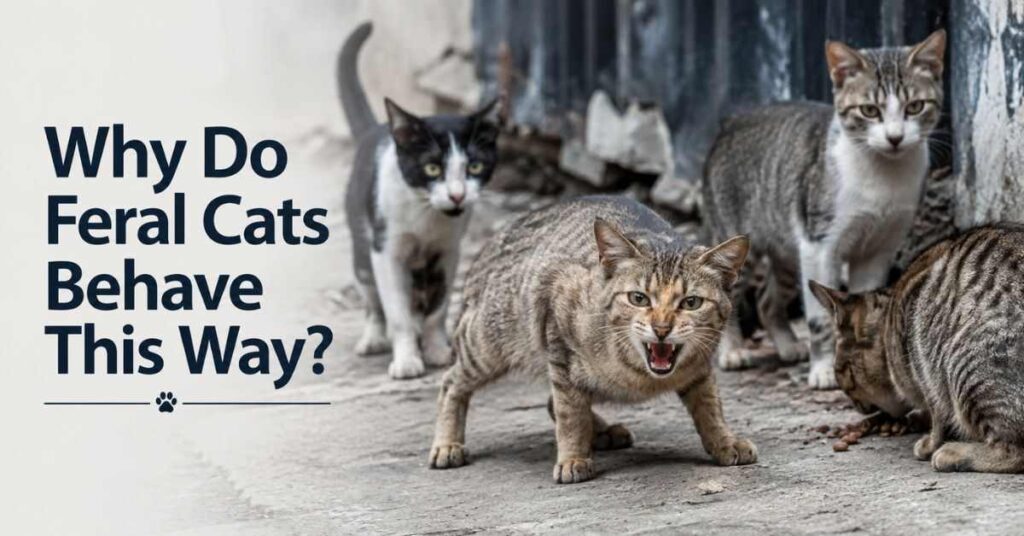
Understanding the “why” behind feral cat behavior makes it much easier to approach these situations with empathy instead of frustration.
Lack of Early Socialization
The critical socialization window for kittens is roughly between 2 and 7 weeks of age. Kittens who don’t experience gentle human handling during this period are far more likely to grow into cats that view people as threats, regardless of how calm or well-intentioned someone is later on.
Survival Instinct
Every behavior from hiding to hissing to avoiding eye contact serves a survival purpose. Feral cats that trusted too easily historically faced greater risk, so caution became an evolved advantage.
Environmental Stress
Cats living outdoors deal with unpredictable food access, weather extremes, predators, and territorial competition. This constant low-grade stress reinforces defensive behavior.
How to Recognize Feral Cat Body Language
Reading a feral cat’s body language can help you avoid dangerous or stressful encounters.
H3: Signs a Feral Cat Feels Threatened
- Flattened ears pressed against the head
- Arched back with raised fur (piloerection)
- Low growling or hissing
- Direct, unblinking stare
- Tail low and puffed, or thrashing
H3: Signs a Feral Cat Is Relatively Calm
- Ears in a neutral, forward position
- Slow blinking from a distance
- Sitting or lying down while watching you
- Tail loosely curled, not thrashing
- Willingness to eat while you’re nearby (though still cautious)
Even “calm” feral cats should not be approached quickly or touched without extensive, gradual trust-building often over weeks or months.
Can Feral Cat Behavior Change?
Yes, but with important caveats. Adult feral cats rarely become fully socialized house pets, though many can learn to tolerate a consistent, calm caregiver over time especially if that person provides regular food.
Kittens, however, have a much higher success rate. If feral kittens are found and gently socialized before around 8 weeks of age, many can be successfully tamed and rehomed as friendly, affectionate pets.
Factors That Influence Behavior Change
| Factor | Impact on Behavior Change |
| Age when socialization begins | Younger = higher success rate |
| Consistency of a caregiver | Builds gradual trust over time |
| Prior human trauma | Can slow or prevent progress |
| Colony environment | Stable colonies show less erratic behavior |
| Health and nutrition | Well-fed cats display less stress-driven aggression |
What You Can Do to Help Feral Cats
If you’ve noticed feral cats in your area, there are responsible, effective ways to help without putting yourself or the cats at risk.
- Support Trap-Neuter-Return (TNR) programs — This is the most widely recommended approach for managing feral cat populations humanely.
- Provide consistent food and water — A predictable schedule reduces stress and territorial conflict.
- Offer basic shelter — Insulated, weatherproof shelters help cats survive harsh conditions.
- Avoid forcing physical contact — Let the cat set the pace; never grab or corner a feral cat.
- Contact local rescues — Many organizations specialize in feral colony management and can guide you.
Understanding feral cat behavior before intervening protects both you and the cat, and it dramatically increases the chances of a positive outcome for everyone involved.
Conclusion
Feral cat behavior isn’t random or unfriendly it’s a finely tuned survival strategy shaped by instinct, environment, and a lack of early human contact. From avoiding eye contact to living in tightly structured colonies, every behavior serves a purpose rooted in safety.
Whether you’re dealing with a colony near your home or simply want to understand these resilient animals better, patience and knowledge go a long way. With the right approach like supporting TNR programs and offering consistent care from a safe distance you can make a real difference in a feral cat’s life.
For more expert guides on cat behavior, care, and health, keep exploring KittyCareZone.com your trusted resource for understanding cats, wild or domestic.
Not exactly. Feral cats display defensive behaviors like hissing or swatting when they feel cornered or threatened, but this is rooted in fear rather than dominance-driven aggression.
Adult feral cats rarely become fully affectionate indoor pets, though some tolerate a trusted caregiver. Kittens socialized before roughly 8 weeks old have much better odds of adapting to home life.
In cat communication, prolonged eye contact can be read as a threat. Feral cats avoid it as a way to de-escalate potential danger and avoid confrontation.
Many feral cats live in colonies centered around related females, especially where food sources are consistent. Males often roam more independently between territories.
Lost pets typically still seek human interaction, make eye contact, and may approach cautiously. Feral cats generally avoid people entirely and show no prior signs of socialization.

Ali Ahmad /Passionate writer sharing informative, engaging, and easy-to-read articles across different topics. Focused on delivering valuable content that helps readers learn, explore, and stay inspired every day.