

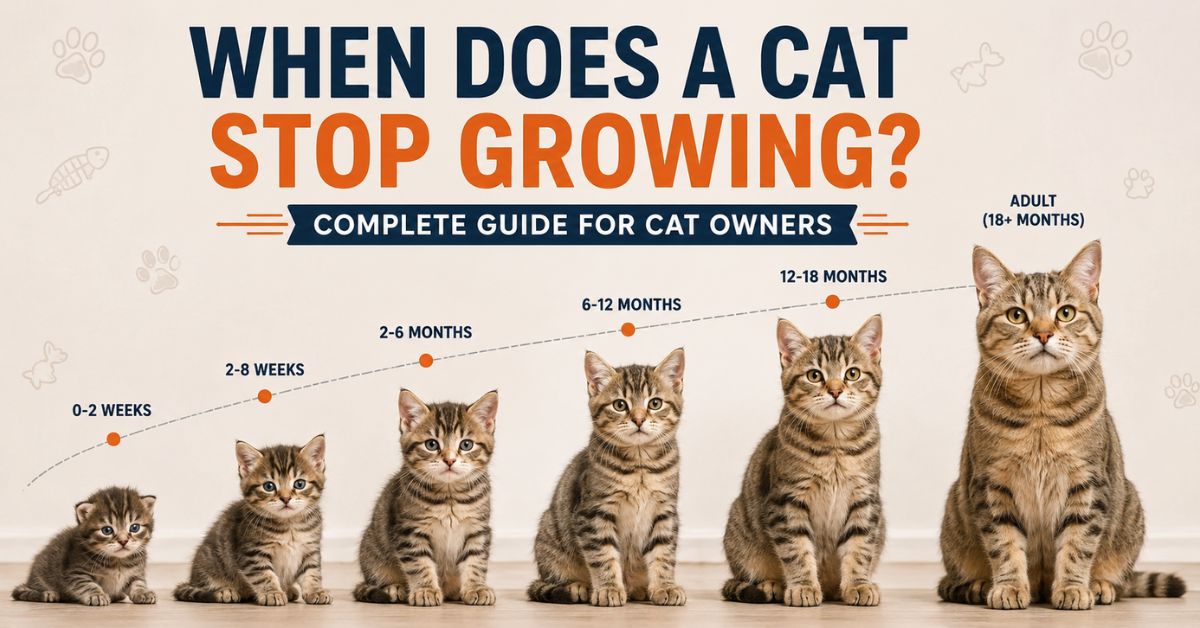
If you’ve recently welcomed a kitten into your home, you may be wondering when does a cat stop growing. Watching a tiny kitten transform into a confident adult cat is exciting, but many owners are unsure about how long this growth process lasts.
The answer isn’t always straightforward because a cat’s growth depends on factors such as breed, genetics, nutrition, and overall health. While many cats reach their full height and length by around one year of age, some continue developing physically for much longer.
In this comprehensive guide, you’ll learn everything about cat growth stages, factors that influence development, and how to tell when your feline friend has reached adulthood.
Understanding Cat Growth Stages
Cats go through several growth phases before becoming fully mature adults. Each stage plays an important role in their physical and behavioral development.
Newborn Stage (0–2 Weeks)
Newborn kittens are completely dependent on their mother. During this period:
- Eyes remain closed for about a week.
- Hearing begins to develop.
- Rapid weight gain occurs daily.
- Movement is limited to crawling.
Healthy kittens typically double their birth weight within the first two weeks.
Early Kitten Stage (2–8 Weeks)
This is one of the fastest growth periods in a cat’s life.
During this stage:
- Eyes fully open.
- Teeth begin erupting.
- Coordination improves.
- Social behaviors develop.
- Weaning starts around 4–6 weeks.
Kittens become increasingly active and curious about their surroundings.
Juvenile Stage (2–6 Months)
Growth remains rapid throughout this stage.
Key developments include:
- Strong muscle growth
- Increased energy levels
- Improved coordination
- Permanent teeth replacement
Many kittens gain approximately one pound per month during this period.
Adolescent Stage (6–12 Months)
Cats begin looking more like adults, although they may still behave like playful kittens.
At this age:
- Growth slows down.
- Body proportions become more balanced.
- Reproductive maturity occurs.
- Personality becomes more defined.
Most domestic cats achieve much of their adult size by the end of this stage.
So, When Does a Cat Stop Growing?
For most domestic cats, the answer to when does a cat stop growing is between 12 and 18 months of age.
However, physical maturity and complete development are not always the same thing.
General Growth Timeline
| Cat Type | Typical Age Growth Stops |
| Average Domestic Cat | 12–18 months |
| Large Breeds | 2–4 years |
| Small Breeds | 10–12 months |
| Mixed Breed Cats | 12–18 months |
| Maine Coon Cats | 3–5 years |
While height and length may stabilize around one year, muscle development can continue beyond that point.
Why Some Cats Grow Longer Than Others
Not every cat follows the same growth schedule.
Several factors affect how long a cat continues growing.
Breed
Breed is one of the biggest influences on growth duration.
Large cat breeds mature more slowly than average-sized cats.
Examples include:
- Maine Coon
- Norwegian Forest Cat
- Ragdoll
- Siberian Cat
These breeds often continue growing well beyond their first birthday.
Genetics
A kitten’s parents can provide clues about future size.
Cats with larger parents tend to grow larger themselves. Genetics influences:
- Height
- Body length
- Bone structure
- Muscle mass
Nutrition
Proper nutrition is essential for healthy growth.
Kittens require:
- High-quality protein
- Essential fatty acids
- Vitamins
- Minerals
Poor nutrition may stunt growth or cause developmental issues.
Health Conditions
Certain medical problems can affect growth patterns.
Examples include:
- Intestinal parasites
- Hormonal disorders
- Chronic illnesses
- Malnutrition
Regular veterinary checkups help ensure healthy development.
Growth Differences Between Male and Female Cats
Gender can influence growth rates and final size.
Male Cats
Male cats generally:
- Grow larger than females
- Develop broader heads
- Build more muscle mass
- Continue growing slightly longer
Female Cats
Female cats often:
- Reach maturity sooner
- Have smaller frames
- Weigh less on average
Although differences vary by breed, males are typically larger overall.
At What Age Is a Cat Fully Grown?
Many owners assume adulthood begins at one year old.
While this is partially true, there are different types of maturity.
Physical Maturity
Most cats reach physical maturity between:
- 12 and 18 months
This includes:
- Full height
- Full body length
- Near-adult weight
Skeletal Maturity
Bones continue strengthening after visible growth slows.
Skeletal maturity often occurs around:
- 18–24 months
Behavioral Maturity
Cats may continue maturing emotionally and behaviorally until:
- 2–4 years old
This explains why some adult cats still display kitten-like behaviors.
Signs Your Cat Has Stopped Growing
Wondering whether your cat is fully grown?
Look for these indicators.
Stable Weight
One of the clearest signs is maintaining a consistent weight for several months.
No Noticeable Increase in Size
You may notice:
- Stable body length
- Stable shoulder height
- Consistent body proportions
Mature Facial Features
Adult cats often develop:
- Broader faces
- More defined cheek structure
- Mature eye appearance
Reduced Growth Spurts
The rapid growth seen during kittenhood disappears as adulthood approaches.
How Big Will My Cat Get?
Many cat owners are curious about their kitten’s future size.
Although exact predictions are difficult, several clues help.
Check the Parents
Parent size often predicts adult size.
Observe Paw Size
Large paws sometimes indicate a larger adult cat, though this isn’t always accurate.
Consider Breed Standards
Purebred cats generally follow predictable size ranges.
For example:
| Breed | Average Adult Weight |
| Siamese | 6–10 lbs |
| American Shorthair | 8–15 lbs |
| Ragdoll | 10–20 lbs |
| Maine Coon | 10–25 lbs |
| Persian | 7–12 lbs |
Mixed-breed cats can vary considerably.
Does Spaying or Neutering Affect Growth?
This is a common question among pet owners.
Research suggests that spaying or neutering does not significantly stunt growth.
However:
- Growth plates may close later.
- Cats may become slightly taller.
- Weight gain risk may increase without proper diet management.
The overall effect on final size is usually minor.
Feeding Your Growing Cat Properly
Good nutrition supports healthy growth and development.
Choose Kitten-Specific Food
Kitten food contains:
- More calories
- Higher protein levels
- Additional nutrients
These support rapid growth and energy needs.
Follow Feeding Guidelines
Avoid overfeeding or underfeeding.
Consult your veterinarian for guidance based on:
- Age
- Weight
- Activity level
- Breed
Ensure Fresh Water Access
Hydration supports overall health and growth.
Always provide clean water.
Avoid Excessive Treats
Too many treats can contribute to unhealthy weight gain and nutritional imbalance.
Common Growth Concerns in Cats
My Cat Seems Smaller Than Other Cats
Size differences are often normal.
Factors include:
- Breed
- Genetics
- Gender
However, consult a veterinarian if growth appears unusually slow.
My Cat Keeps Getting Bigger After One Year
This can be perfectly normal, especially in large breeds.
Some cats continue filling out and building muscle until age three or older.
My Kitten Isn’t Gaining Weight
Possible causes include:
- Parasites
- Poor nutrition
- Illness
Veterinary evaluation is recommended.
How to Monitor Your Cat’s Growth
Tracking growth helps ensure your cat develops properly.
Consider:
- Monthly weigh-ins
- Growth photos
- Veterinary wellness exams
- Body condition scoring
Monitoring progress allows early detection of potential issues.
Growth Tracking Tips
- Use the same scale each time.
- Record weight monthly.
- Compare changes over time.
- Discuss concerns with your veterinarian.
Consistent tracking provides valuable insights into your cat’s health.
The Importance of Regular Veterinary Care
Routine veterinary visits support healthy growth.
Your veterinarian can:
- Monitor weight gain
- Assess body condition
- Recommend proper nutrition
- Detect health problems early
Preventive care is one of the best ways to help your cat reach its full potential.
Conclusion
Understanding when does a cat stop growing helps owners provide the right nutrition, healthcare, and expectations throughout their pet’s development. Most cats reach their adult size between 12 and 18 months, although larger breeds may continue growing for several years. Genetics, nutrition, breed, and overall health all play important roles in determining a cat’s final size.
By monitoring growth, feeding a balanced diet, and scheduling regular veterinary checkups, you can help your feline companion thrive at every stage of life.
For more expert cat care guides, health tips, and feline advice, visit KittyCareZone.com and continue learning how to give your cat the happiest and healthiest life possible.
Most cats stop growing between 12 and 18 months old. Larger breeds such as Maine Coons may continue growing until 3–5 years of age.
Yes. Male cats are generally larger, heavier, and more muscular than female cats.
Yes. While many cats reach most of their adult size by one year, muscle development and body filling can continue for several more months or years.
Neutering usually does not stop growth. Some cats may grow slightly taller because growth plates close later.
Signs include stable weight, no noticeable increase in size, mature facial features, and reduced growth spurts.

Ali Ahmad /Passionate writer sharing informative, engaging, and easy-to-read articles across different topics. Focused on delivering valuable content that helps readers learn, explore, and stay inspired every day.
1 thought on “When Does a Cat Stop Growing? Complete Guide for Cat Owners”